Truly connect-and-play, with no need install PC card;
4 or 8
channels, with built-in independent differential
amplifier for each channel;
Most transducers
or sensors need no separate amplifier;
Maximum
at 100,000 samples/sec at 16-bit;
Window-based
modes: SCOPE,CHART and XY;
Powerful
easy-to-use software for recording, display/review
and analyses;
GlobalTown™ offers the
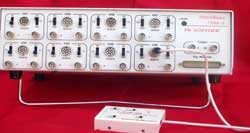
high-performance data acquisition systems, ThinkWave™ 1600
series, featuring sensor/transducer-ready differential inputs, real-time
recording, one-line
display/review and measurements, and easy-to-use integrated software, Acquest™,
as
well as connect-and-play hardware. The compact, versatile systems are the
most
cost-effective system in the market.
ThinkWave™ features the novel proprietary Smartbuff™
technology. With data buffer size
at least 1000 times more than that in competitors' (up to 128MB), the
ThinkWave™
systems provide unmatched capabilities such as simultaneous direct recording-to-disk,
real-time display and on-line measurements/analyses of multi-channel data,
at sampling
rate up to 100,000 samples per second, without interruptions. They enable
seamless,
on-the-fly changes in recording/display modes and/or other parameter while
data
recording and display are in progress. The systems can also be used for
recording, without
interruptions, for long hours in the buffer memory.
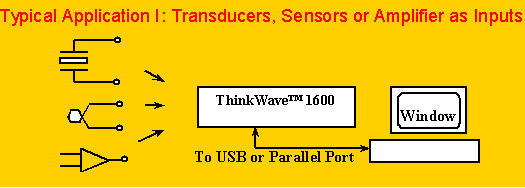
The ThinkWave™ 1600 systems provide differential inputs with
individually
software-selectable gain up to x1000 for each channel. With built-in voltage
excitations for
every channel, most transducers or sensors can be used directly on the
data acquisition
systems without modifications. This translates into sizable savings in
system costs for
applications in many laboratories and industries, as no additional bridge
amplifiers are
needed for transducer/sensor experiments.
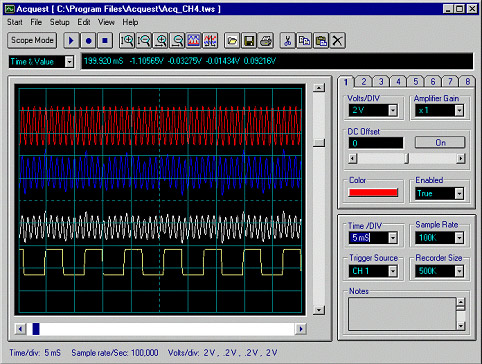
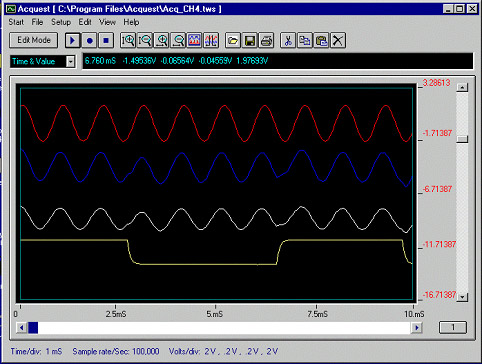
The powerful software, Acquest™, offers multiple interactive
interfaces for data recording,
display/reviewing, analyses and transformations. The setup and use of
the interfaces are
intuitive and very user-friendly. There are three modes of data acquisition
and display:
CHART, SCOPE and XY. Data acquisition controls include, among others,
channel setups,
flexible triggering, on-line commenting of recorded data. Display and
review options include
on-line zoom (in time from ms to min and in vertical scales) and shift
without loss of data,
real-time data value display and measurement tools, etc. The Acquest™
software contains
a variety of analysis functions, ranging from simple to complex, including
on-line/off-line
digital filtering, data channel computing, data transformations, sophisticated
rise time/peak
detection functions, comprehensive statistical analyses, and many more.
All data can be exported easily to other to spread sheets software such
as Microsoft®
Excel.
ThinkWave™
1600-4/8 systems vs. Competitions
Features
ThinkWave 1600 4/8
Most DAC Systems from
Competitors
Analogue input
Direct differential inputs with high CMMR, no need for separate
amplifier for most signals;
Mostly with single-ended inputs, need separate amplifiers for small
signals;
Transducers & sensors
Direct attachment to the "SENSOR" connector, no need for
separate bridge amplifier for most transducers/sensors;
Mostly need separate transducer and conditioners;
Input gain
x1, x10, x100, x1000 software-selectable gain for each channel;
Largely x1 gain with a multiplexing analogue buffer;
Real-time features
Unmatched capabilities, for example: simultaneous recording-to-disk,
real-time display and on-line measurements analyses;
Limited capabilities in recording and review/measurements, simultaneously
and in real-time zoom in/out;
Digital memory buffer
16-128MB proprietary SmartBuff™technology;
Mostly in 8-64 KB range;
AC/DC selection
Selectable for each channel, useful for small signal /w large DC
offset;
Mostly use value shift by software, may saturate input;
Cross-talk & grounding
Easy to reduce cross-talk by grounding unused channel(s).
No channel grounding means;
Conditioned analogue signal output
Provides conditioned analogue signal outputs of each channel for
synchronization and others;
No analogue signal output;
Input signal manifold
Use a DB-25/DB-37 standard connector, useful for multi-channel applications,
such as EEG, ECG, etc;
Mostly no compact manifold, only individual connectors for conditioned
signal input;
Software functions
Integrated, supplied with the hardware system;
Many modularized, customers have to pay for some basic functions;
Portability & mounting
Single box, both rack-mountable and portable;
Mostly multi-component system, not suitable for field application;
Prices
50-100% less
50-100% more
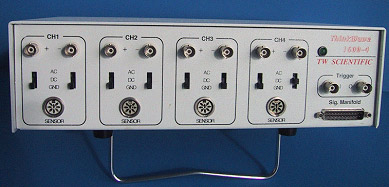
Four-Channel ThinkWave™ 1600-4
Specifications
HARDWARE
(ThinkWave™1600-4/8)
1. Analogue
Input
Input channels
Standard 4 or 8 differential channel inputs,
(both BNC and DIN);
Input coupling
DC or AC (0.15Hz) or GND, selectable;
Sensor inputs
Direct through DIN-8 connector
with excitation voltage of ±5;
110/220V
AC for lab use or
+15 VDC or battery pack for field application;
Acquest™
SOFTWARE
1. Display and Record Modes SCOPE and CHART Modes
Easy one-button mode change;
Default setting for mode and channel setup, easy to
use.
USB or Parallel Port
2. Display, Record and Software Control
Display field selection (1 to 8 channels);
The full screen display capability for every channel;
Independent gain and position adjustment for each channel;
Reviewing while recording without loss of data;
Trigger channel selectable;
Sample rate and record duration adjustable;
Recording notes field;
3. Data Analysis Data Review:
Zoom in/out in both X- and Y-axis for field of view
enlargement/reduction;
Time base change for all channels simultaneously, vertical
scale change independently
for each channel, offset (position) adjustment independently for each
channel;






 Home>>Data
Acquisition
Home>>Data
Acquisition

 Truly connect-and-play, with no need